Software Engineer, Equity Strategist, Polymath.
Posts tagged Agents
Why Multi-Agent Systems are the Next Frontier in AI Architecture
1 day
by Ray Tawil
in Programming
What makes multi-agent AI architecture distinct from traditional single-model deployments?
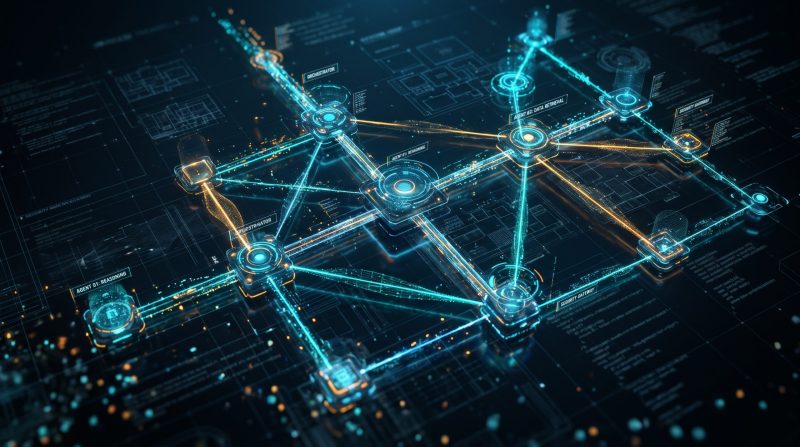
Traditional AI implementations typically rely on a single, monolithic model handling prompt evaluation, reasoning, and output generation in a linear fashion. In contrast, multi-agent architecture decouples complex workflows into specialized, autonomous units. Each agent operates with a defined role, a constrained set of tools, and localized contextual memory. By replacing a single heavy prompt loop with modular delegation, the system minimizes context window bloat, improves task precision, and significantly reduces compute overhead.
How do multi-agent systems maintain data integrity and execution security?
As autonomous agents gain agency to query production databases, interact with external APIs, and execute arbitrary code, security must shift from perimeter defense to protocol-level governance. Ensuring deterministic execution requires strict schema enforcement, explicit permission scopes, and structured input/output validation. Much like distributed network architecture or cryptographic ledgers, trust in an agentic ecosystem relies on verifiable boundaries—verifying payload authenticity at every hop rather than assuming implicit safety.
What are the primary engineering bottlenecks when scaling autonomous workflows?
Scalability in multi-agent orchestration is primarily limited by latency compounding, state synchronization failures, and non-deterministic error propagation. When an upstream agent returns an ambiguous payload, downstream agents can drift into recursive retry loops or hallucinated state transitions. Mitigating these failure modes requires strict communication protocols, explicit timeout handling, and comprehensive telemetry logging to ensure that complex agentic pipelines remain auditable, predictable, and resilient in production.