Software Engineer, Equity Strategist, Polymath.
Posts tagged rabbitMQ
The Case for Event-Driven Architecture in Modern System Design
6 hours
What are the key limitations of traditional request-response patterns?
Traditional request-response models rely on tight coupling between client and server. When a client issues a synchronous HTTP or RPC call, it blocks execution while waiting for the target service to process the request and return a payload. As applications scale into distributed microservices, this synchronous pipeline becomes fragile. A single slow downstream service or database bottleneck creates a cascading delay across the entire call stack, degrading latency and introducing single points of failure across dependent nodes.
How does event-driven design improve system decoupling and operational resilience?
Event-driven architecture (EDA) replaces synchronous blocking calls with asynchronous message passing. Instead of invoking endpoints directly, services emit immutable event notifications to an intermediary message broker or log stream (such as Apache Kafka, RabbitMQ, or Redis Streams). Consumer services subscribe to relevant event streams and process data independently at their own pace.
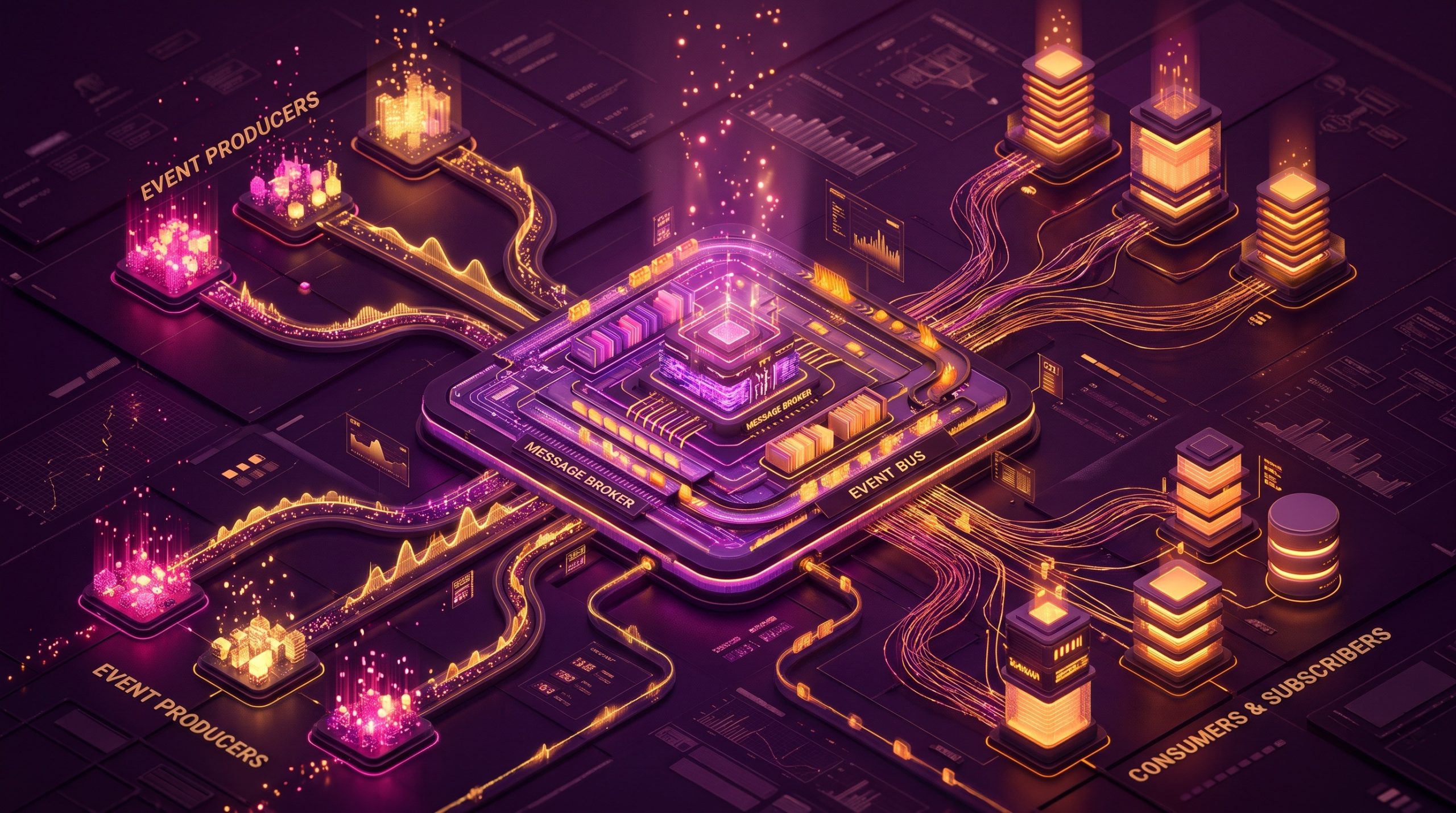
This model delivers three distinct structural advantages:
- Decoupled Workflows: Producers emit state changes without requiring awareness of downstream consumers or their availability.
- Elastic Scalability: Consumer groups can scale horizontally to handle backpressure during traffic spikes without impacting upstream producers.
- Fault Isolation: If a consuming service fails, incoming events persist in the message broker queue until the service recovers and resumes processing, preventing data loss.
What engineering trade-offs must be evaluated before migrating?
While event-driven architectures solve high-concurrency scaling challenges, they introduce operational complexity. Distributed systems moving away from strict transactional consistency must account for eventual consistency, requiring explicit handling for out-of-order message delivery, duplicate event processing via idempotent consumers, and complex distributed tracing to debug state across asynchronous message queues. For systems where immediate transactional consistency is mandatory, hybrid architectures combining synchronous ingress with asynchronous processing often provide the optimal balance.